

The Kelpies Prize for Writing

The Kelpies Prize for Writing 2026: Winner Announced!
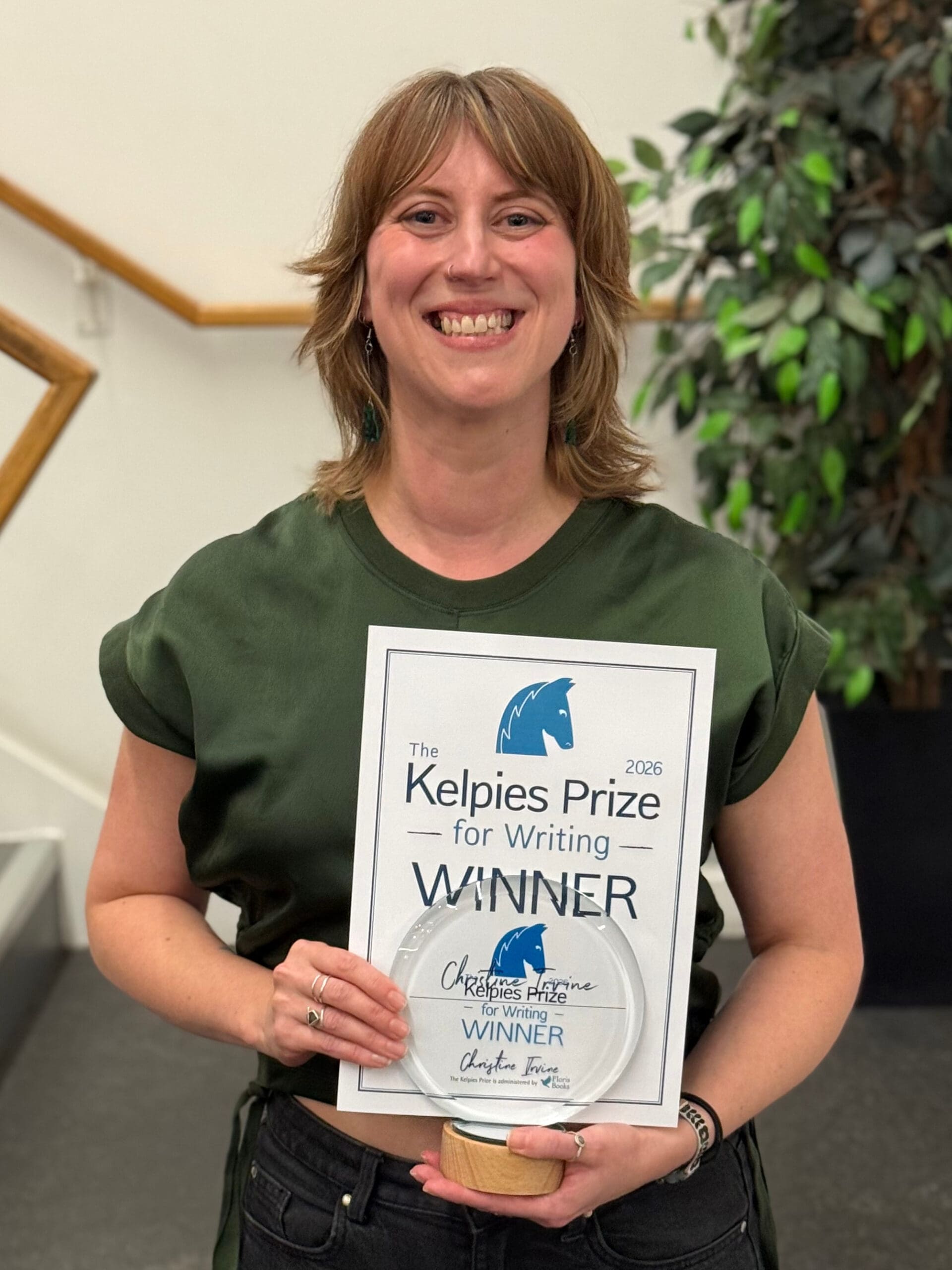 Massive congratulations to Christine Irvine, the winner of the Kelpies Prize for Writing 2026!
As well as receiving a £500 cash prize, Christine will now embark on 9 months of mentoring with the Floris Books editorial team. We’re excited to see her skills and creativity develop during this process!
Entrants to this year’s prize were asked to submit either the first five chapters of a children’s book or a complete picture book text, a synopsis for their book, and a short piece of writing for children from a choice of prompts.
Watch author and storyteller Janis Mackay read Christine’s winning entry below, or keep scrolling to read an extract!
Kelpies Prize for Writing 2026 Winner: Christine Irvine
Christine Irvine is a queer writer from East Kilbride who now lives in the southside of Glasgow. In 2024, she organised the first Southside Book Hunt, partnering with local businesses to help over 100 kids get their hands on free books. Christine loves writing stories and characters that don’t quite fit, and hopes her stories might be comforting for any young people trying to figure out who they are. When she’s not writing, Christine loves swimming, aerial circus, drawing and bookbinding. She volunteers with a local community meals initiative called Kin Kitchen and with the Glasgow Film Theatre.
The judges were impressed by Christine’s ability to grab the reader’s attention from the off, and particularly enjoyed her skilled weaving of lyrical storytelling with drama and tension.
In Christine’s middle-grade entry, Water and Wild Things, a heatwave sees 12-year-old Alison trying to escape her warring parents, distant sister and local bullies by hiding out in the Greenery – a patch of forest in the middle of her housing estate. But deep within all the green someone else (or something else) is hiding too – a shapeshifter, marooned far from home by the drought. In this extract, Alison, venturing into a tunnel in the forest to cool off, encounters this unexpected creature. But are they friend or foe…
My gaze darted over the dark wall of the tunnel. The glitter of reflected sunlight stuck to the damp bricks and for a second I thought I’d imagined them – eyes, in the wall, haha – but no; as my own gaze adjusted to the gloom I found them again. A pair of eyes. They blinked at me: once, slow. I stared back.
“Don’t hurt me,” I breathed.
Further down the tunnel, water dripped. Drip. Drip drip.
The eyes blinked again. The whites had a yellowish tinge around the outside and the centres were as dark as the tunnel around us, a deep, muddy black.
For a minute that stretched out and out like chewing gum I didn’t speak and I didn’t move; I could hardly make myself breathe and so I could hear the other creature’s breath just barely an arm’s length away from me, shuddery and fast and flat. Like it was scared. Maybe it was scared.
“Are you hiding?” I whispered.
Then, all at once, the eyes – the thing attached to the eyes – moved. It moved, and when it moved it rustled, rattled, breathed out with a sound like dead leaves dancing across a pavement and I dug my heels into the mud and tried to push myself up, away, back onto my feet. My fingernails scraped concrete.
Maybe it was angry.
Drip. Drip drip.
It peeled itself away from the bricks. It seemed to be made of too many parts, too many limbs, too many bones. The eyes appeared and disappeared. Sunlight painted wobbly stripes and dots across its slimy skin. Scaly skin. Rumpled skin. Inky black hair slunk downwards towards the water like seaweed.
“I’m Al!” I stammered, maybe shouted. My mouth wasn’t working that well. “I’m Al, I’m… I’m hiding too.”
It was hard to see in the shadows. But as I stared at it, its whole form seemed to push and pull, like modelling clay in invisible hands. It kept changing. But the eyes stayed the same. Stayed fixed on mine.
“I didn’t mean to get in your way,” I told it. “It’s just… it’s so hot. It’s cool in here.”
A strange feeling was starting in my head: it felt thick and clogged, like when you hold your breath and drop underwater in the swimming pool and all the bright echoing sounds of other people fade away.
“It’s so hot,” I tried again. “It’s never normally like this here. Usually it rains all summer…”
I don’t know why the words kept coming out. My skin felt weird; fizzy. The dank tunnel seemed to be shrinking around me, squeezing, pushing air out of my lungs.
“Do you like the rain…?” I asked, stupidly. “I do… I like—”
Then a laugh sliced open the thick summer air. My head snapped up and I squinted into the hot white glare of sunlight beyond the tunnel entrance.
Others.
The creature moved again, this time a sharp jerk sideways, and I reached out with my left hand: “No – don’t, they’re not nice people, they won’t—”
And then its mouth opened and its long head darted forward and its teeth snatched at my outstretched arm.
I shouted, pain flashing red through my body. But that was enough to shock some sense into me – throwing a last glance at the monster, I shoved myself away from the wall and took off running, slipping and sliding until I crashed out of the tunnel and into the blistering heat of the afternoon.
History of the Kelpies Prize
The Kelpies Prize was launched in 2004 to find the best new Scottish writing for children. Our very first winner, Mike Nicholson, continues to be one of our best-loved authors to this day, and many more of our winners and shortlisters have gone on to have sparkling writing careers.
In 2019, we changed the format of the prize to reflect our new aims of nurturing and developing children’s writers in Scotland, asking entrants to submit a selection of writing samples as opposed to a complete manuscript. In addition, we introduced an all-new prize package including a mentoring programme with our experienced editorial team.
Find out more about our past Kelpies Prize winners.


Join our Mailing List!
Get the latest news, book releases and special offers, straight from the Kelpies' Mouth.

The Kelpies Prize 2026: Winners Announced!