


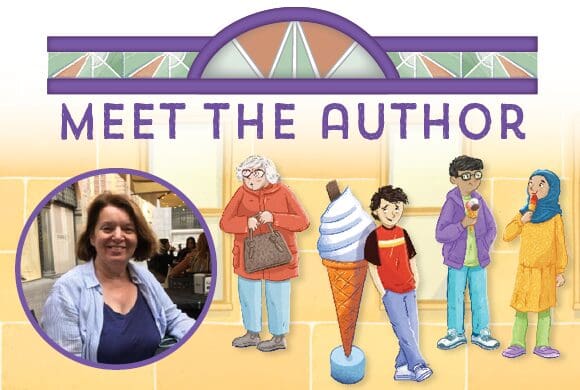
Author Interview: Lindsay Littleson
Posted on 21/05/2024 in Authors Lindsay Littleson
Ice Cream Boy is the latest heart-warming novel from Lindsay Littleson, author of Carnegie-nominated Guardians of the Wild Unicorns. Full of authentic dialogue, gentle humour and true-to-life characters, this engaging middle-grade novel explores the thoughts and feelings of children affected by dementia.
We asked Lindsay about the new book, life as a writer and, of course, ice cream.
 Important question first: what’s your favourite ice cream flavour?
My favourite flavour is coconut, but the only ice cream I’d turn down is rum and raisin. All other flavours are very acceptable.
Can you describe Ice Cream Boy in 5 words?
Emotional, funny, moving, heart-warming, hopeful
Is Verani’s based on or inspired by a real ice cream shop?
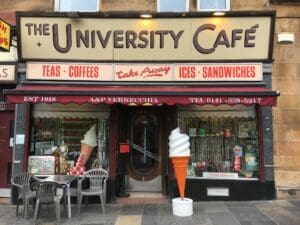
In my teens I had a friend called Franco Varani, whose family run an ice-cream shop in Ayrshire and I borrowed and slightly altered his surname for the book. But my fictional Glasgow ice cream shop is based on the old-fashioned appearance of the University Café and Queens Café.
What’s your favourite scene from the book?
I thoroughly enjoyed writing the scene when Luca arrives in Tuscany for the first time, and travels to the gorgeous walled town of Lucca, because they brought back lovely memories of visiting the town for the first time myself. I can highly recommend Lucca as a city break destination!

But as we followed Aunt Julia through the city’s narrow, winding lanes, the air felt much cooler. The alleys were lined with buildings so tall the sun couldn’t reach the ground. Breathing in the smells – leather from the handbag shops, strong cheese, cured salami – I pushed all thoughts of Dad to the back of my mind and started to enjoy myself.
I’ve finally made it to Tuscany. I’m here!
Aunt Julia stopped at the end of the lane and gestured at Uncle Gordon and me to get a move on.
“Plenty of places to eat here.”
According to the sign, we were in Piazza Citadella, but we might as well have jumped into a poster on the wall of Verani’s. The buildings, painted apricot and terracotta and sunshine yellow, glowed in the bright sunlight. Scarlet flowers spilled from massive pots on the paving stones. A dark-haired girl rode a blue bicycle confidently across the square. Big umbrellas provided shade for diners in the open-air cafés. A skinny cat sunned itself beside a large bronze statue of a man relaxing in a chair.
 Who was the most difficult character to write?
Nonna was probably the most difficult. Her relationship with Luca is so warm and has been so crucial to him throughout his childhood, and describing the gradual disintegration of her personality was tough, particularly as I had recent experience of trying to cope with my own mum’s dementia. Whatever age we are, it is horrible when a close relative no longer recognises us, but how equally awful and scary it must be for the person with dementia.
The characters in Ice Cream Boy face some very difficult situations – how do you find the balance between portraying the situation honestly and not making the book too heavy?
Some of the scenes in the book, particularly those which deal with the effects of Nonna’s dementia, were hard to write and I was aware that they would be heart-breaking to read. But I wanted to be completely honest with my readers, because I was aware some of them would face similar situations with an elderly relative with dementia and didn’t want them to feel they were alone. But there is hope, humour and lots of love in the story which hopefully balances any darker moments.
Do you have any advice for children in Luca’s / Sitara’s / Kamal’s shoes?
My advice would always be to share any problems with a trusted adult. Don’t try and deal with issues alone. There are lots of online support and resources available and in the resource pack I’ve created for teachers there are links to charities and support groups both for children dealing with relatives with dementia and for refugees.
Luca’s dad’s family are from Barga, Italy. Have you ever been? What made you choose this Italian town?
 A lot of Scots-Italians come from the area and there are several familiar surnames on Barga’s war memorial, including Nutini! It’s a lovely village in the Tuscan mountains and one day last October, my partner Ian and I took a bus up there from the town of Lucca so that I could do a little last-minute research. It turned into quite an adventure, as the bus back to Lucca wasn’t due until evening and the afternoon train was cancelled. Luckily, we were helped out by a lovely Italian lady who explained that there would be a replacement bus along in half an hour. So, we bought our tickets in the bar and sat outside, enjoying delicious gelatos and noting all the Scottish connections we’d discovered: the annual fish and chip festival, the shop selling porridge and irn bru, saltires flying in several places and now, a replacement bus service!
 Is the Glasgow setting meaningful to you?
Lucca lives in Tassie Street in Shawlands, in the flat where I was born and spent my early childhood. It was my parents’ first home together and my mum said their friends envied them because it had two bedrooms and a dairy on the ground floor..
I remember as a very small child going out in a rowing boat in the big pond at Queens Park with my grandpa. Because I was writing about a subject that felt very personal to me, I decided to set the story somewhere that had been really important to both myself and my mum.
What’s your process for writing a book? How does the initial idea turn into a whole novel?
The process is less than scientific and can be a bit messy! I scribble ideas, draw my characters, make a rough plan on post-it notes or in one of my many notebooks and then start writing and see what happens.
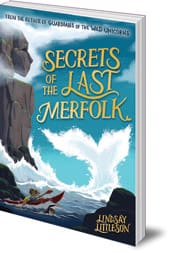
Your previous two novels with Floris Books, Guardians of the Wild Unicorns and Secrets of the Last Merfolk, were fantasy adventures. How does your approach change between writing fantasy and a more realistic story like Ice Cream Boy?
The approach is fairly similar, as although Guardians of the Wild Unicorns and Secrets of the Last Merfolk have magical, fantasy elements, both stories are very much set in the real world and the child characters have their own complex family issues.
About Ice Cream Boy:
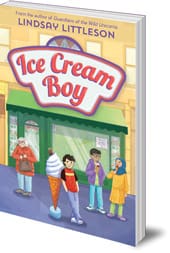 Twelve-year-old Luca Verani has big plans for his future: he’s going to take over his family’s Glasgow ice cream cafe. But when his aunt announces she’s selling the failing business and his nonna’s mind starts to wander, Luca’s dreams seem to be melting away…
‘An amazing, heart-warming tale of fractured families, dementia and delicious secret ice cream recipes!’
— Maisie Chan, author of Keep Dancing, Lizzie Chu

Also by Lindsay Littleson:
Explore the blog by category
Click to select a category.
Join our Mailing List!
Get the latest news, book releases and special offers, straight from the Kelpies' Mouth.

The Kelpies Prize 2027